Pilot Programs
Part of AI procurement and pilot programmes
Choosing a pilot owner and approval criteria
Assign an AI pilot owner, record decision rights and set adoption gates before seeing results.
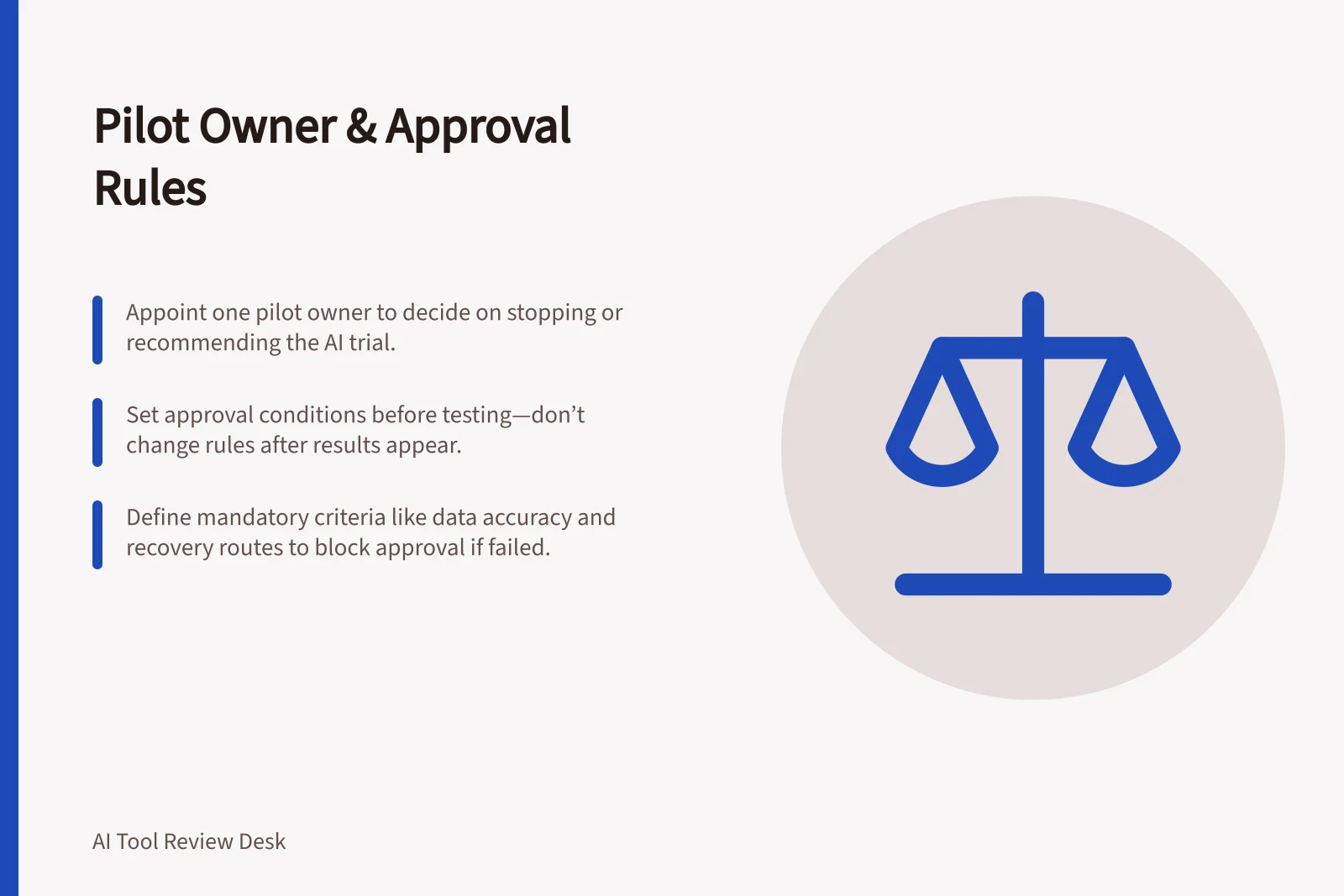
Appoint one accountable business owner for the AI pilot. That owner can stop the exercise and present its recommendation. Name separately who may approve data use, spending and any eventual deployment. Set approval conditions before results appear, so a persuasive demonstration cannot change the decision rule halfway through.
Assign the decision rights
The owner should represent the work the tool is meant to improve. They need to define the business result, secure reviewer time, resolve ordinary trade-offs and account for exceptions. They may need specialist approval for matters outside their authority.
Treat these as practical pilot roles rather than prescribed job titles. Assign each decision to a person with authority to make it:
Decision or work / Named owner to record
- Business result and recommendation
- Pilot owner
- Source facts and acceptable output
- Task expert
- Data boundary and account permissions
- Relevant privacy and security owners
- Spending and purchase terms
- Budget and contract owners
- Day-to-day exceptions
- Person able to take over the task
One person may hold several roles. The record still needs to show which decisions that person can make and which require another approval.
Assigning Decision Rights in an AI Pilot
- Business result and recommendationPilot owner
- Source facts and acceptable outputTask expert
- Data boundary and account permissionsRelevant privacy and security owners
- Spending and purchase termsBudget and contract owners
- Day-to-day exceptionsPerson able to take over the task
Set approval criteria that can stop the purchase
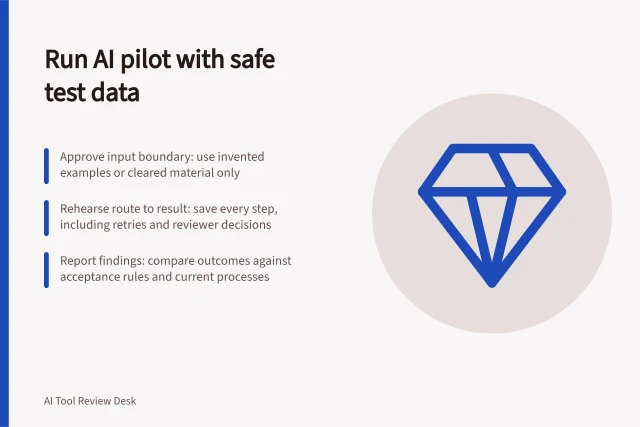
Start with the task’s finish line and the effort needed to reach it. For a fictional supplier-enquiry draft, a required result could retain every condition in the approved information sheet, identify missing details and avoid an unsupported promise. The reviewer must also be able to check and hand over the draft with acceptable effort compared with the current process.
Separate mandatory conditions from qualities that allow judgement. An unauthorised input, consequential wrong claim or failure with no owned recovery route may block approval even if other outputs are good. Record the evidence for variable qualities such as clarity or ease of editing. Use “cannot judge” where a material source or account answer is missing.
Do not adopt a percentage threshold merely because a form offers one. If a numerical threshold helps, set it from the task’s consequences, baseline and available review capacity before testing.
Close with a bounded sign-off
The owner’s recommendation should state the tested conditions, material failures, remaining questions and proposed use. Each specialist records a decision for the matter they own.
Any adoption approval names the permitted users, task, data classes and human check. If approval depends on a changed plan, source, setting or workflow, test that condition before extending the use boundary.
Key Governance Metrics for AI Pilots
- Named pilot owner
- Yes
- Defined business result
- Required
- Approved data classes
- Specified
- Human check requirement
- Mandatory
- Permitted users defined
- Yes
- Testing under changed plan before expansion
- Required