Cost & Limits
Part of AI tool costs and usage limits
Estimating cost per accepted output
Calculate AI cost per accepted result, including paid usage, staff review, corrections, setup and rejected attempts.
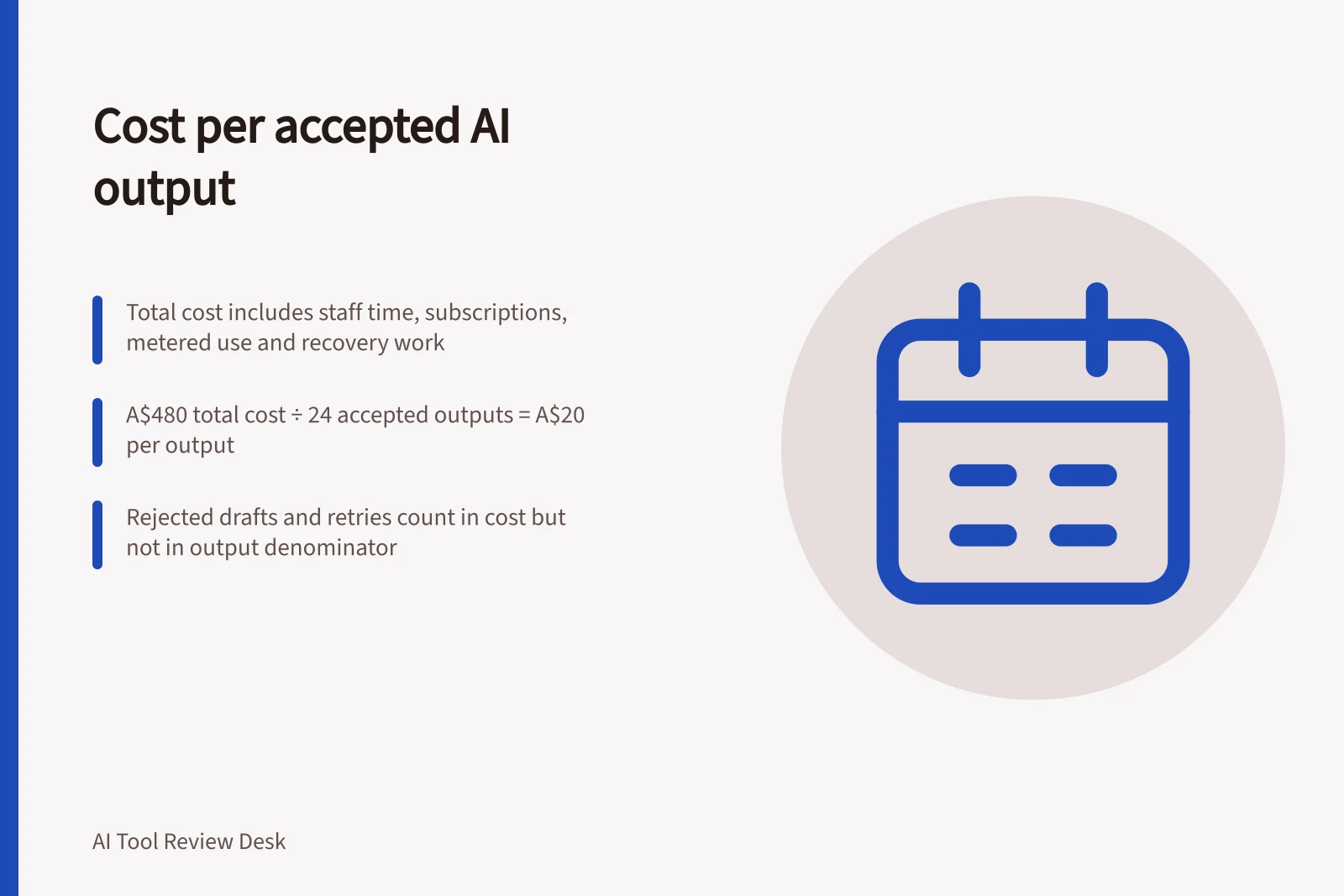
Cost per accepted output equals the total cost allocated to a defined AI workflow over a period divided by the number of completed results that meet its acceptance rule. Include the cost of rejected attempts, retries and human repair. Count each accepted result once; a draft that is rejected does not enter the denominator.
Define the result
Choose a unit with a clear finish line, such as an approved reply draft or a completed record. Set the acceptance rule before comparing routes: required facts, permitted editing, reviewer and errors that make a result unusable.
Keep different work types separate. A routine reply and a complex exception may need very different preparation and review effort.
Build the total cost
For the same period as the accepted-output count, add:
- Committed access:seats and fixed fees allocated to this task. State the allocation rule when a subscription supports other work.
- Metered use:billed requests, tokens, tools or credits, including unsuccessful attempts that incur charges.
- Staff time:input preparation, checking, correction, approval and exception handling, valued using a stated internal assumption.
- Setup and upkeep:integration, templates, training and maintenance allocated over a stated period.
- Recovery:work moved to an approved manual or alternative route after a failure or limit.
Avoid counting the same expense twice. If an internal staff-cost estimate already includes supervisor review, do not add that review again. Show cash spending separately from the broader total that includes internal time when both views matter.
A provider bill helps identify metered charges, but it cannot tell you how many outputs your team accepted. The billable unit can vary by plan and feature—such as tokens, credits or requests—so use the unit that applies to the selected route, not the number of visible answers.
Calculate an example
Suppose one month's task allocation is A$200 for a subscription, A$80 for paid usage, A$160 for staff time and A$40 for setup. These are hypothetical worksheet amounts, not provider prices or observed costs.
The total is A$480. With 24 accepted outputs, the cost is A$480 ÷ 24 = A$20 each. With the same total cost and only 16 accepted outputs, it is A$30 each.
Record attempts, rejected drafts and elapsed time alongside the figure. A result that arrives after its required deadline may fail the acceptance rule even if its text is correct. If there are no accepted outputs, report the total cost and zero accepted results; cost per accepted output is undefined.
Use the figure to decide
Compare suitable routes using the same task mix, acceptance rule and cost period. Show routine and difficult cases separately before giving a combined figure.
If review time dominates, a lower model rate may have little effect. If metered use dominates, inspect input size, retries and optional tools. If a limit forces manual recovery during busy periods, include that work in the busy-period estimate.