Cost & Limits
Part of AI tool reliability
Reviewing availability commitments for business use
Read an AI provider’s availability terms by checking covered traffic, downtime rules, exclusions, credits and your own recovery deadline.
Check an AI availability commitment by reviewing the service and the requests it covers, how downtime is counted, its exclusions and the available remedy. Compare that promise with your own work deadline.
Identify the route and business deadline
Record the product, account, plan, model, API method or app feature, relevant region and connected services. Obtain the agreement and order form that would apply to the Australian buyer.
A public service-level page may describe an offering the account has not purchased. Record who can open a support case and what logs the team can supply.
Ask the task owner when staff must take over. A nightly internal report may tolerate a delay that a customer-facing reply cannot. Set that operational limit even if the provider has not declared an incident.
Read the measurement rule
Check whether the commitment measures uptime, successful requests, server errors or latency. Read the definition of a valid request, the measurement period and any minimum incident duration. Then inspect exclusions for quotas, invalid inputs, preview features, customer configuration and dependent services. A status page may help explain an incident but does not replace the contractual calculation.
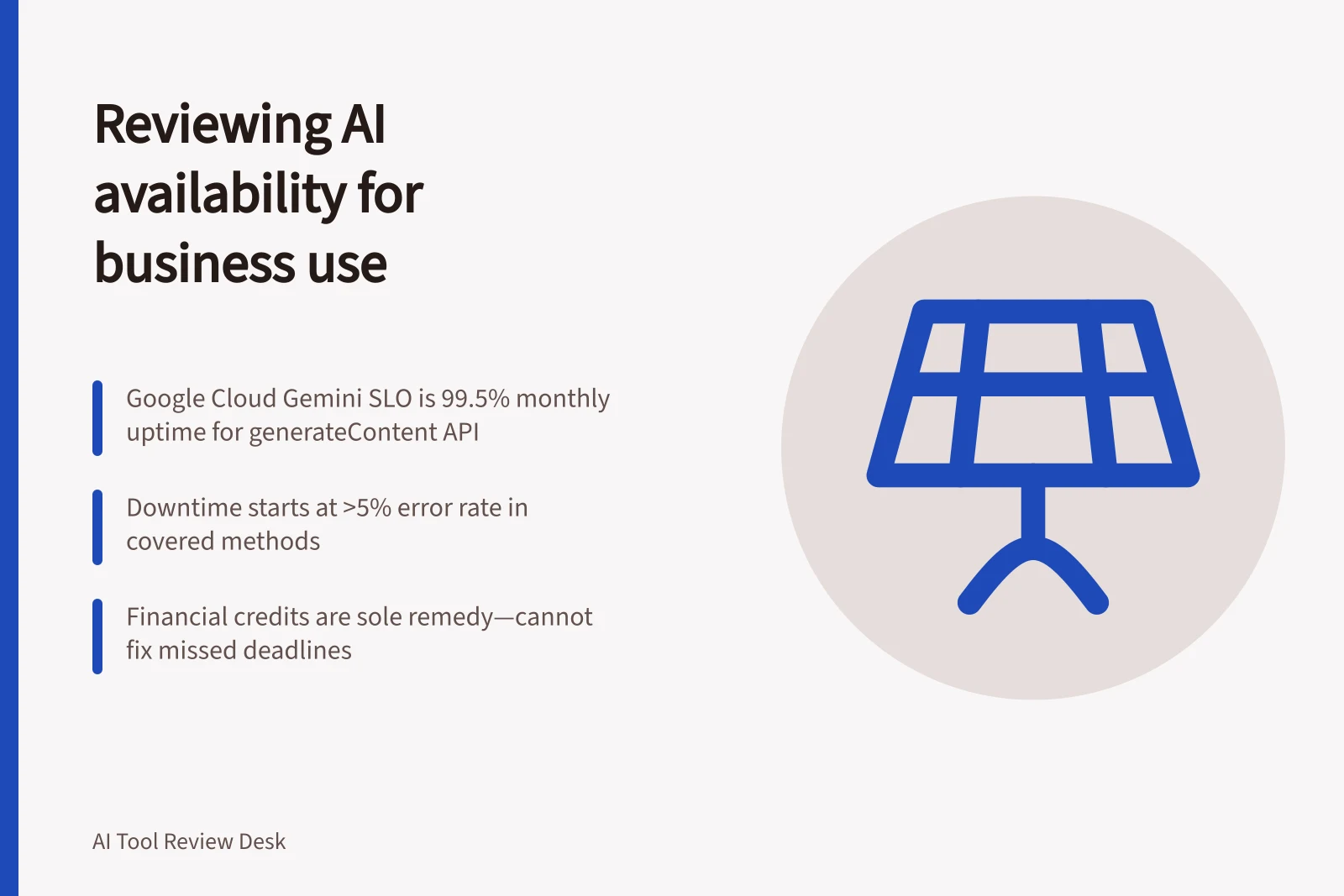
Google Cloud Gemini online inference. The current Google Cloud agreement states a 99.5% monthly uptime objective for the covered generateContent and streamGenerateContent methods, or 95% for models designated for shorter availability. Its downtime definition begins by defining “Downtime” as more than a five per cent Error Rate.
If Google does not meet the SLO and the customer meets its obligations under the SLA, the customer is eligible to receive Financial Credits, determined on a calendar month basis per Project. The SLA states that this is the customer's sole and exclusive remedy for a failure to meet the SLO. These terms concern the named Google Cloud service, not every Gemini product or request.
Key Availability Metrics for Business Use
- Google Cloud Uptime Target
- 99.5% monthly
- Downtime Threshold
- >5% Error Rate
- Remedy Type
- Financial Credits
- Exclusion Scope
- Customer config, quotas, preview features
- OpenAI Credit Policy
- None – no financial compensation
Decide how work continues
For each candidate, record the covered route, objective, valid-request rule, exclusions, claim process, support channel and task deadline. Mark a missing term as unresolved. Check whether request logs can show the affected time and task without collecting unnecessary business data.
Decide what happens before any contractual claim could help: wait and retry within a safe limit, use an approved alternative or hand the item to a person. Assign an owner to unfinished work. A financial credit may offset a service bill, but it cannot restore a missed business deadline. Revisit the decision after a plan, model, connected service or contract change.